Shimla
Tag: # Artificial intelligence

BUEST organize workshop on Artificial Intelligence and Machine Learning
Computer Science and Engineering Department, Baddi University of Emerging Science and Technology conducted a workshop on February 17, 2025, to provide valuable knowledge and guidance on Artificial Intelligence and Machine Learning (AI and ML) for B.Tech CSE students. The session was led by Ms. Priya Yadav from SOFCON India Pvt. Ltd.The seminar included an insightful presentation and an interactive discussion led by Ms. Priya Yadav. She emphasized the importance of continuous learning, adaptability, and resilience in the ever-evolving field of AI. She also shared key insights into entrepreneurship, industry expectations, and emerging technologies, inspiring students to pursue excellence and innovation. During the interactive session, students actively engaged with the speaker, seeking advice on career opportunities, skill enhancement, and industry trends. Ms. Yadav openly shared her experiences, offering practical guidance tailored to students’ aspirations.
Shoolini University hosts transformative program on Artificial Intelligence
Solan, January 24
Yogananda School of Artificial Intelligence Computers and Data Science at Shoolini University, in partnership with ACM Student Chapter, successfully conducted a 7-day intensive program titled “Deep Dive into Generative Artificial Intelligence.” The event, held from January 16th to 22nd, 2024, in an offline mode, diverse group of young minds from various schools across Himachal Pradesh.
Financially supported by the Innovation Hub for Cobotics (IHFC) at the Indian Institute of Technology (IIT) Delhi, the program welcomed 63 students from grades 9th to 12th. These students represented nine esteemed educational institutions, including Vardhman Mahavir Public School, Mahavir Public School, Paradise Public School, all from Sundernagar; Guru Gobind Singh Public Senior Secondary School, Modern Hi-Tech Model School, DAV Public School Gohar from Mandi; SVM Roura Bilaspur; Crescent School Bilaspur; and GSSS Mandhorghat Shimla.
The inaugural ceremony, was attended by prominent academicians and industry experts, which was a fountain of inspiration and motivation for the participants. Prof. Virender Rihani, Dean of the School of Engineering at Shoolini University, opened the event with a welcome address. The ceremony was further enlightened by the insights of Prof. Lynn R. Carter from Arizona State University, Dr. Samiya Khan from the University of Greenwich, Mr. Rishi Pratap Singh from Infosys, and Dr. Ashima Yadav from Bennett University.
Dr. Ritu Khosla from IIT Mandi, Dr. Rather Gousia from IIT Delhi, and the team from Shoolini University, including Mr. Piyush Sewal, Mr. Aarchit Joshi, Ms. Kritika Rana, Ms. Ruchika Sharma, and Mr. Anitya Gupta, admirably led the programme. They provided comprehensive theoretical and practical knowledge on topics such as the fundamentals and foundation of Generative AI, embedding algorithms, RNNs, LSTMs, neural machine translation, ChatGPT, and LLMs. Out of the 63 registered participants, 54 successfully completed the training, marking a significant milestone in their educational journey.
In the valedictory ceremony attended by Prof. Ashish Khosla, Director of Innovations, and Dr. Ashoo Khosla, Chief Learning Officer at Shoolini University, sharing their expertise and experiences in prompt engineering and its applications.
Dr. Arvind Sharma, the Program Incharge, expressed deep gratitude to all participants, school coordinators, speakers, supporting organizations, and Shoolini University departments for their invaluable contribution to the programme’s success. He reassured the participants of the university’s commitment to hosting similar future events, aimed at enriching the knowledge and skills of young learners.

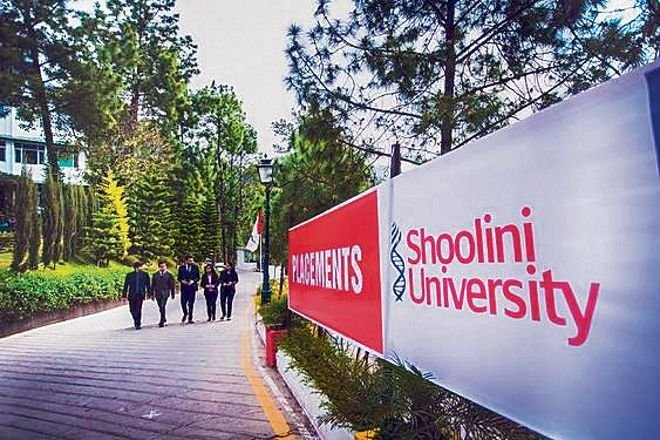
Discussion on Artificial intelligence for creative writing held at Shoolini University
Solan, February 7
Belletristic Shoolini Literature Society organised a panel discussion on the topic “When machines become storytellers, where does the human mind go?”

Setting out the central theme of the discussion, Dr. Amar Raj Singh, Director, Shoolini Centre of Distance and Online Education, Shoolini University, said that the disruptive technologies that ultimately changed the world, such as steam engine, electricity, and calculators, initially met with resistance, but these technologies ended up creating new jobs and opportunities and that those who disregarded these technologies were left behind.
Dr. Amar Raj said, “AI tools can help generate ideas and complete sentences, paragraphs and even articles or essays based on the prompt provided. They can assist with research by providing information on a specific topic, answering questions, and summarizing long articles or books. In addition, they can proofread a text and suggest corrections for grammar, spelling, and punctuation. They can not only generate creative writing prompts and new ideas for writers to explore, but also provide summaries of books, articles, and even news events, allowing individuals in the humanities to quickly catch up on relevant topics.” He also talked about ChatGPT – a type of modern-day disruptive technology – and its use in fields like writing scripts, essays, and emails, creating codes, and so on. “Instead of banning this tool, humanists should master it first, and for that to happen, the whole education system needs to be revamped,” he added.
Professor Manju Jaidka, Dr. Navreet Sahi, Prof. Nasser Dasht Peyma, Dr Purnima Bali, and Mr. Hemant Sharma greatly contributed to the vibrancy of the discussion.


