



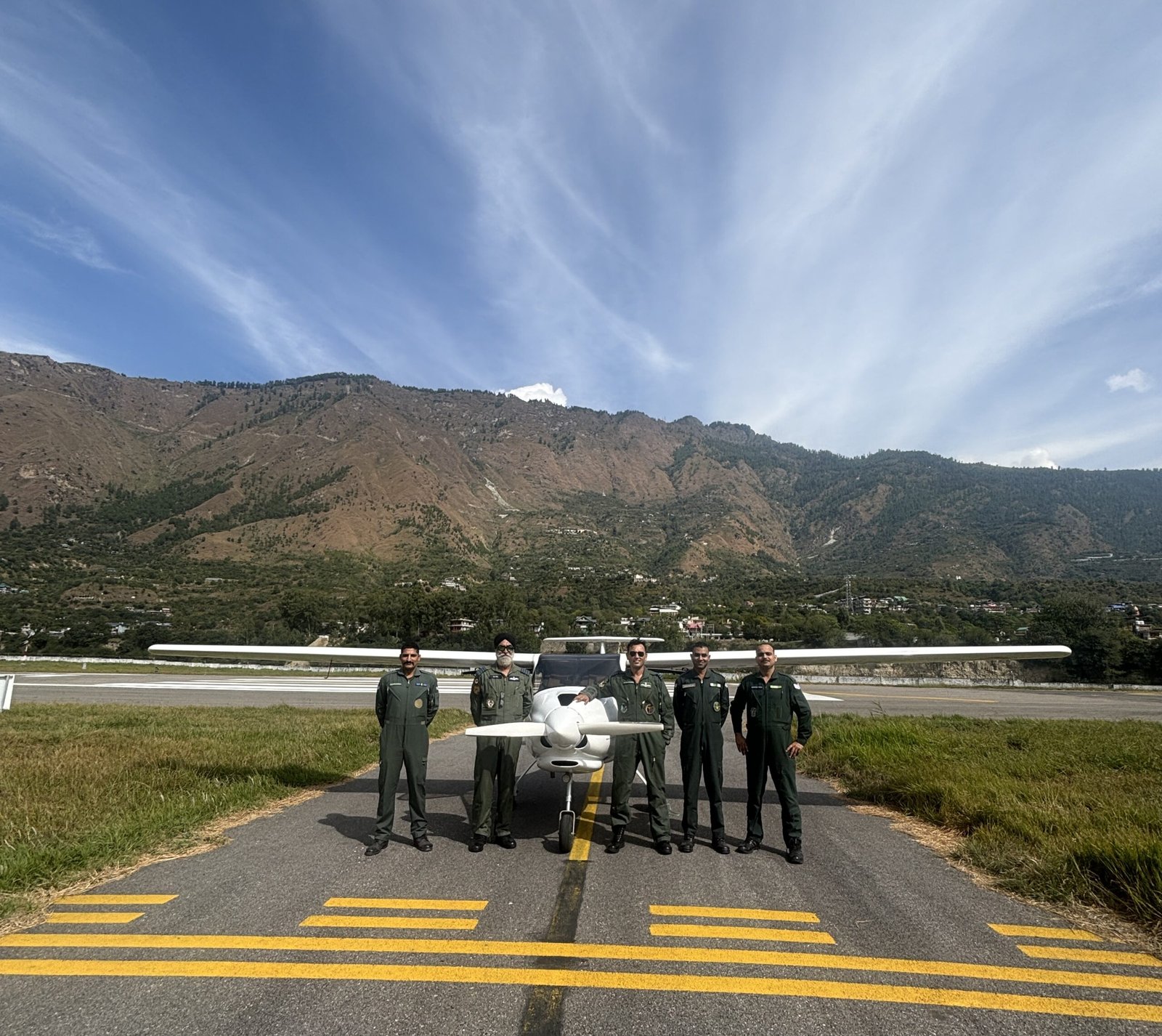
Kullu, 14 October 2026: In a landmark development for the National Cadet Corps (NCC) and aviation training in Himachal Pradesh, the first NCC microlight aircraft landed at Kullu Airport today, marking a historic step towards establishing a dedicated flying training facility for NCC cadets in the state. The achievement represents the culmination of nearly three decades of efforts to bring aviation infrastructure to Himachal Pradesh and opens new opportunities for the state’s youth to experience flying in the challenging and picturesque Himalayan valley.
The aircraft was flown by Group Captain Baljinder Singh Gill, Commanding Officer, 4 Punjab Air Squadron NCC, Ludhiana, and Wing Commander Kunal Sharma, Commanding Officer, 1 Himachal Pradesh Air NCC Unit, Kullu.
Behind this historic achievement lies a sustained campaign of planning, coordination and execution led by Wing Commander Kunal Sharma, whose persistent efforts over the last two-and-a-half years have been instrumental in transforming a long-pending aspiration into a tangible reality.
Two-and-a-half years of persistent effort
Recognising the long-standing requirement for a dedicated NCC aviation facility in Himachal Pradesh, Wing Commander Kunal Sharma spearheaded efforts to mobilise resources, coordinate with multiple agencies and resolve the administrative, infrastructural, security and operational challenges involved in making the Kullu facility functional.
One of the principal challenges was arranging the necessary funds and institutional support for the construction and completion of the aircraft hangar. Through sustained follow-up and coordination with the State Education Department, Airports Authority of India and district administration, the requisite support was progressively mobilised to bring the infrastructure to operational readiness.
Beyond the construction of the hangar, the initiative required the establishment of essential security arrangements, including CCTV surveillance and associated security infrastructure, alongside the coordination of aviation-related requirements. The effort extended well beyond the creation of a physical structure, encompassing the multiple systems and procedures necessary to support safe and organised flying activities.
Navigating a complex multi-agency process
Establishing the flying facility required close coordination among the Bureau of Civil Aviation Security (BCAS), Directorate General of Civil Aviation (DGCA), Airports Authority of India (AAI), State Government authorities, district administration and NCC authorities.
Wing Commander Sharma coordinated with the concerned stakeholders to progress the required permissions, inspections, approvals and inter-agency arrangements, including the Memoranda of Understanding necessary for establishing the facility and enabling local flying activities.
The formulation of Standard Operating Procedures (SOPs) was another critical component. Detailed procedures covering valley flying, circuit flying and the ferrying of aircraft from Patiala to Kullu were developed approximately three months before the aircraft’s arrival. These efforts were supported by trial landings conducted a few months earlier by Wing Commander Kunal Sharma and Group Captain Pankaj Bhardwaj, which helped assess the operational feasibility of flying activities in the valley and informed the preparation for subsequent operations.
The successful arrival of the aircraft today reflects the cumulative outcome of these sustained efforts, involving infrastructure development, security preparedness, operational planning and coordination among multiple agencies.
State support and institutional collaboration
The operationalisation of the facility was made possible through collective institutional support. The State Education Department extended crucial financial assistance to the Airports Authority of India, while AAI’s contribution and cooperation and the assistance of the district administration played an important role in completing the infrastructure and progressing the project.
The initiative demonstrates how persistent follow-up at the unit level, combined with the support of government departments and aviation authorities, can overcome longstanding administrative and infrastructural challenges.
Bringing flying opportunities to Himachal’s cadets
Until now, NCC cadets in Himachal Pradesh had to travel to Patiala to undertake flying activities, involving considerable time and logistical effort. With the Kullu Flying Node becoming operational, cadets will have the opportunity to access flying activities within their own state and gain first-hand exposure to aviation in the distinctive geographical and meteorological conditions of the Himalayan valley.
The facility is expected to strengthen aviation training under NCC, inspire young people to explore careers in the Indian Air Force and civil aviation, and promote technical awareness, confidence and skill development among the youth of Himachal Pradesh.
For Wing Commander Sharma, the achievement represents the successful culmination of a sustained institutional effort in which infrastructure, funding, security arrangements, regulatory coordination and operational procedures had to progress together. For the NCC in Himachal Pradesh, it marks the beginning of a new chapter in aviation exposure and training.
A legacy beyond infrastructure
The landing of the first aircraft at Kullu is more than an aviation milestone. It symbolises the transformation of a nearly three-decade-old aspiration into a practical opportunity for the state’s youth. The journey highlights the importance of perseverance, administrative initiative and multi-agency cooperation in delivering facilities that create lasting public value.
With the aircraft now at Kullu and the dedicated infrastructure brought to operational readiness, Himachal Pradesh has taken a significant step towards making aviation more accessible to its NCC cadets.
After nearly three decades of waiting, the skies over Kullu have opened a new horizon for Himachal’s youth. The milestone reflects not only the arrival of an aircraft, but also two-and-a-half years of sustained effort by Wing Commander Kunal Sharma and the collective commitment of the agencies that helped turn a long-standing dream into reality.