




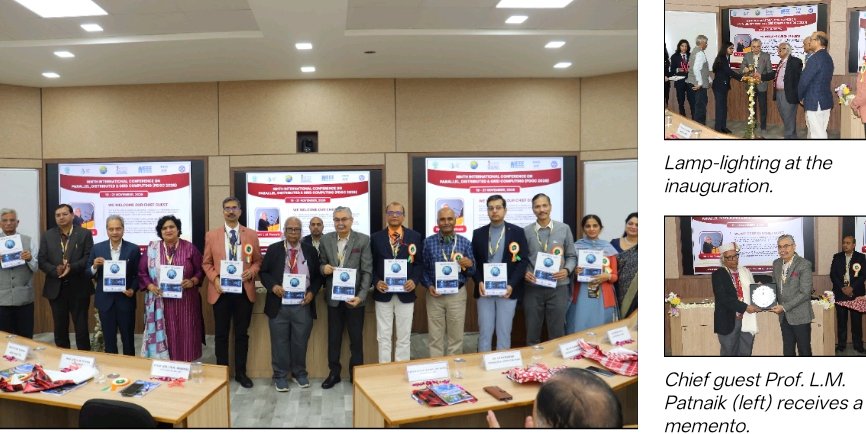
WAKNAGHAT (SOLAN), November 22
The growing role of high-performance computing in accelerating artificial intelligence (AI) took centre stage as the ninth International Conference on Parallel, Distributed and Grid Computing (PDGC 2026) opened at Jaypee University of Information Technology (JUIT), Waknaghat, on Thursday.
The three-day international conference began with a ceremonial lamp-lighting ceremony, followed by keynote addresses from eminent experts in computing and technology.
The chief guest, Prof. L.M. Patnaik, former professor at the Indian Institute of Science (IISc), Bengaluru, and former vice-chancellor of the Defence Institute of Advanced Technology, Pune, delivered the inaugural keynote titled “High Performance Computing: A Hastener of Spring Time for AI?”
Explaining the technological foundations of modern AI, Patnaik highlighted how graphics processing units (GPUs) and parallel computing accelerate the complex calculations required to train neural networks. Using the analogy of distributing examination papers among multiple evaluators, he explained how parallel processing allows several operations to be performed simultaneously. He also discussed the limitations of parallel computing when certain tasks must be completed sequentially.
Citing weather forecasting as an important application, he underlined the growing significance of high-performance computing in solving complex, data-intensive problems.
The afternoon keynote was delivered online by Prof. K. Gopinath, former faculty member of IISc, whose research expertise spans operating systems and data storage. His address, titled “Computational Positivism and Its Role in AI and Other Areas”, examined the broader relationship between computational approaches, artificial intelligence and emerging technological applications.
Organised by JUIT’s Department of Computer Science and Engineering and Information Technology in hybrid mode, the conference has technical sponsorship from the IEEE Delhi Section.
The 2026 edition focuses on developing scalable computing systems capable of handling increasingly complex workloads, supporting AI-driven applications and improving energy efficiency. Its 10 research tracks cover emerging areas including cloud computing, quantum computing and energy-efficient data centres.
Four parallel technical sessions were scheduled on the opening day, with research paper presentations and two additional keynote addresses lined up during the conference.
The event will conclude on November 21, bringing together researchers, academicians and technology professionals to exchange ideas on the future of parallel, distributed and high-performance computing.