


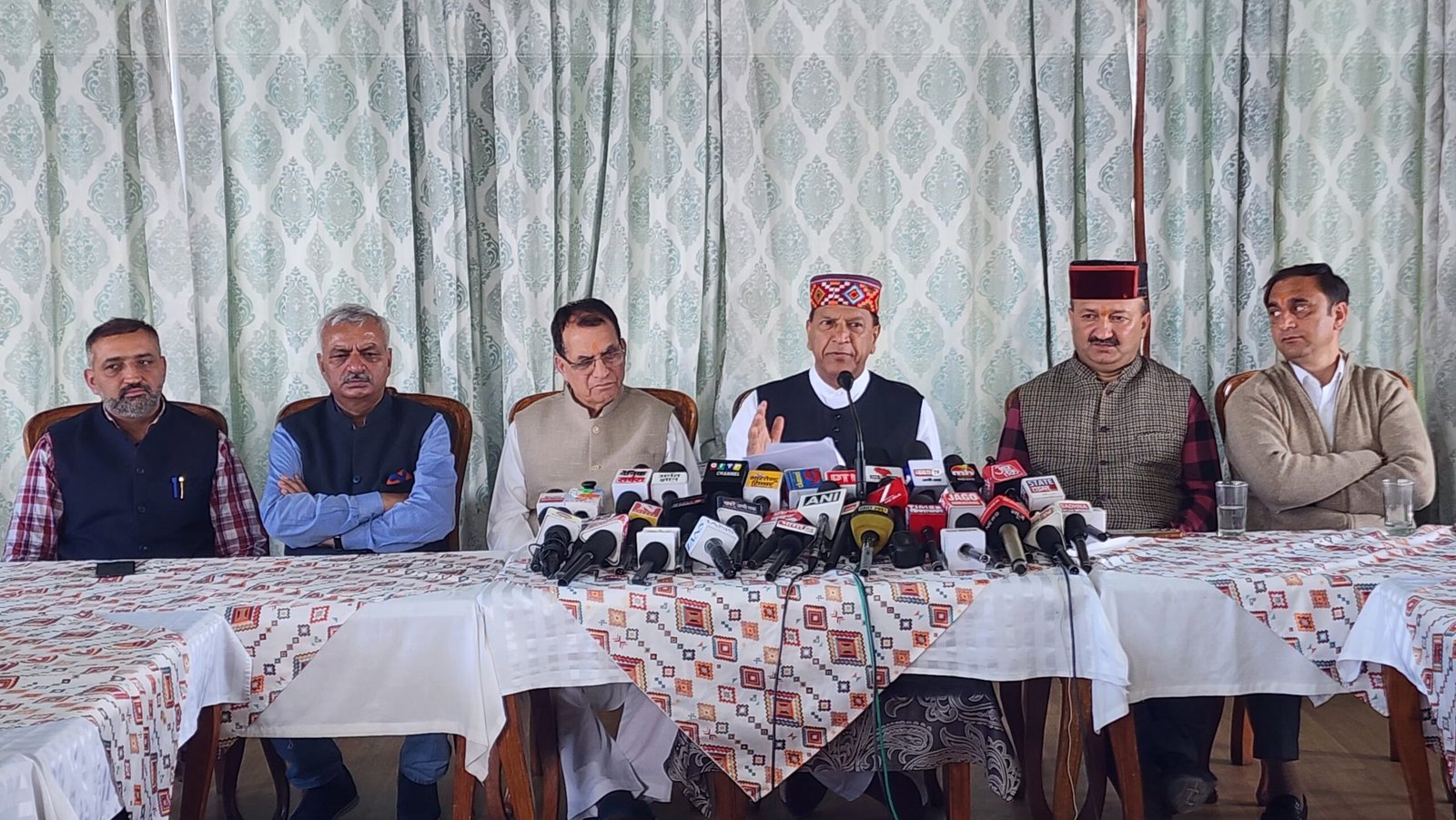
Shimla, September 21: Himachal Pradesh BJP president Dr Rajeev Bindal has questioned the financial and other implications of the recently concluded Kishau Dam agreement, alleging that the Congress government has compromised the state’s long-term interests.
Addressing a press conference, Bindal said the BJP welcomed the agreement involving the six participating states but sought complete disclosure of its implications for Himachal Pradesh, particularly its water rights, irrigation potential, future revenue and employment opportunities.
Centre’s contribution to project highlighted
Bindal said the estimated cost of the Kishau Dam project is ₹15,624 crore, including a water component of ₹12,096 crore and a power component of ₹3,528 crore. He said the Union government’s decision to bear the cost of the water component had removed a major financial hurdle that had kept the project stalled for decades.
According to Bindal, the Centre’s decision in principle in 2025 to assume financial responsibility for the water component paved the way for the agreement signed on September 15, 2026. He also claimed that the Centre would bear rehabilitation costs associated with displaced families.
Questions ₹1,764-crore investment decision
Bindal said Himachal Pradesh and Uttarakhand had agreed in 2015 to share the cost of the power component equally. With the power component estimated at ₹3,528 crore, he said Himachal Pradesh’s share would have been ₹1,764 crore.
He questioned whether the government had adequately assessed the potential long-term benefits of retaining its investment and associated rights in the project. He further demanded disclosure of any independent financial comparison between the earlier investment arrangement and the revised agreement.
Seeks clarity on Himachal’s water rights
Bindal also raised questions about Himachal Pradesh’s share of water from the Tons river. Referring to an earlier water-sharing arrangement, he said Himachal Pradesh and Uttarakhand had been assigned 1.7 per cent each, while Haryana, Uttar Pradesh, Delhi and Rajasthan had been allocated 40.6 per cent, 30.1 per cent, 10.4 per cent and 6.3 per cent, respectively.
He claimed that Himachal Pradesh’s entitlement was approximately 50 million cubic metres and questioned whether the revised agreement had altered the state’s rights. He sought clarification on whether any changes were permanent and what safeguards would apply if the state’s domestic, agricultural or industrial water requirements increased in the future.
Questions CM’s ₹1,200-crore annual revenue projection
Referring to Chief Minister Sukhvinder Singh Sukhu’s reported projection of around ₹1,200 crore in annual revenue for Himachal Pradesh, Bindal questioned why the state had opted against direct investment if the project was expected to generate such substantial returns.
He sought disclosure of the assumptions behind the projection, including electricity generation, the state’s entitlement, expected sale price, operating expenditure and net revenue. He also called for an assessment of future electricity market conditions and the potential impact of increasing solar power capacity on electricity tariffs.
Raises concerns over Sirmaur irrigation potential
Bindal alleged that the interests of farmers in Sirmaur had not been adequately protected and argued that the Kishau Dam should be viewed not only as a power-generation project but also for its potential to support irrigation and agricultural development.
Citing the Giribata project and irrigation development in the Paonta Doon region, he said adequate water rights and irrigation infrastructure could create opportunities for agriculture and horticulture in Sirmaur.
He demanded an assessment of the potential irrigation area, proposed canal networks, agricultural productivity and possible impact on farmers’ incomes.
BJP seeks local employment safeguards
Bindal also sought details on employment and business opportunities for local residents. He asked whether the agreement contained provisions for employing Himachali youth and providing opportunities to local contractors and entrepreneurs.
He demanded disclosure of the expected number of direct and indirect jobs, the proposed share for local residents, and provisions for skill development, technical training and rehabilitation-linked employment for affected families.
Demand for white paper
The BJP president demanded that the state government release the complete agreement and issue a comprehensive white paper on the Kishau Dam project.
He said the document should clearly outline the financial contributions of the Centre and participating states, Himachal Pradesh’s water and electricity entitlements, projected revenue, investment obligations, irrigation provisions, rehabilitation measures and local employment opportunities.
Bindal reiterated that the BJP welcomed the resolution of the longstanding interstate issue while maintaining that the state’s decisions concerning water, electricity, agriculture and employment required greater public scrutiny.