



New facility brings Artificial Intelligence, high-performance computing and bioinformatics together to support next-generation research
Solan, September 2
Shoolini University has strengthened its research capabilities with the inauguration of the BioAI and Advanced Bioinformatics Lab at its Cancer Research Centre. The new facility brings together Artificial Intelligence (AI), high-performance computing, bioinformatics and biotechnology to support advanced research and innovation in biology and healthcare.




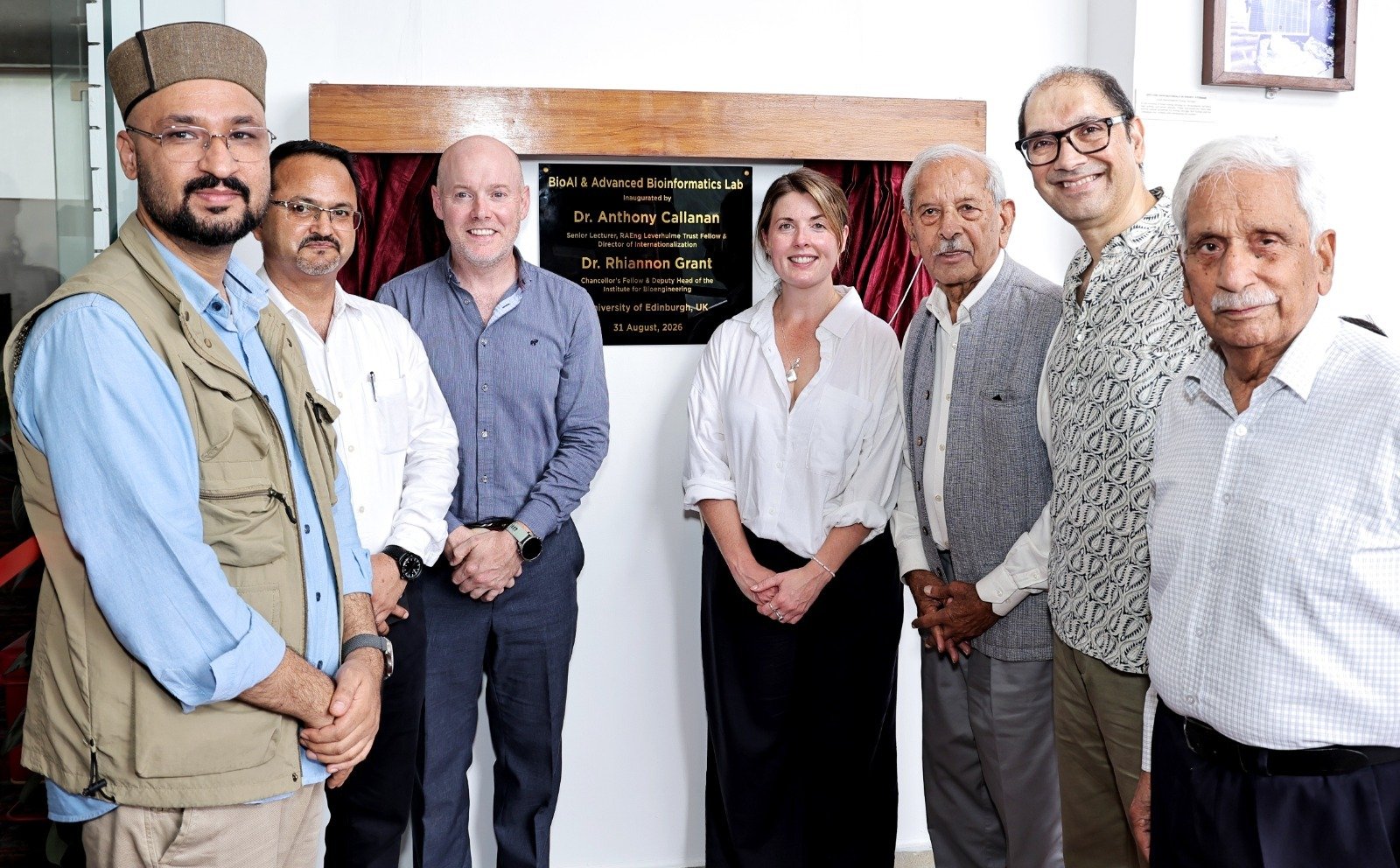
The laboratory was inaugurated by Dr Anthony Callanan, Senior Lecturer and Director of Internationalisation, and Dr Rhiannon Grant, Chancellor’s Fellow, University of Edinburgh, United Kingdom, in the presence of Chancellor Prof. Prem Kumar Khosla, Vice Chancellor Prof. Atul Khosla, Prof. Dinesh Kumar, Dean, Faculty of Applied Sciences and Biotechnology, Prof. Pankaj Kumar Chauhan, Head, School of Bio-engineering and Food Technology, and Prof. Julka, Director, Planning, along with senior university officials, faculty members and students.
Speaking on the occasion, Vice Chancellor Prof. Atul Khosla highlighted the growing role of Artificial Intelligence in scientific research and its potential to transform work across disciplines. He further added that “AI is changing the way research is conducted across disciplines. With the BioAI laboratory, we aim to strengthen the use of computational intelligence in biotechnology and biomedical research and provide our students and researchers with the skills needed for the future.
Prof. Dinesh Kumar, Dean, Faculty of Applied Sciences and Biotechnology, said AI and computational skills would become increasingly important for the next generation of biotechnology professionals. Biotechnology is becoming increasingly data-driven, and an understanding of AI and computational methods will be essential for future researchers and professionals, he said.
Prof. Pankaj Kumar Chauhan, Head, School of Bio-engineering and Food Technology, said the new facility would complement the University’s academic programmes and research ecosystem. The School offers programmes including B.Tech and M.Tech in Bioinformatics, PhD programmes and biotechnology programmes, providing students with opportunities to develop expertise across biological and computational sciences.
Prof. Lokender Kumar, Professor, School of Biotechnology and Coordinator of the BioAI and Advanced Bioinformatics Lab, said the integration of biological knowledge with computational intelligence would play an important role in the future of biotechnology. BioAI provides an opportunity to combine biological knowledge with computational intelligence to analyse complex data, improve prediction and support new approaches to biological research,” he said.
The laboratory has been equipped with advanced computing infrastructure, including NVIDIA GPU Blackwell systems, to support computationally intensive research. It also features advanced iMac systems for programming, machine learning, AI model development and computational research.
The facility will support research involving large-scale biological data analysis, molecular modelling, biomolecular simulations, computational biology and AI-assisted biological prediction. Potential areas of application include cancer biology, genomics, molecular interaction studies and drug discovery.
A key objective of the laboratory is to promote collaboration among biologists, biotechnologists, bioinformaticians, computational researchers and AI scientists. Bringing these disciplines together can enable researchers to approach complex biological and biomedical challenges from multiple perspectives.